
We Built Free Timed Practice Exams for All Four Claude Certifications

Co-Founder
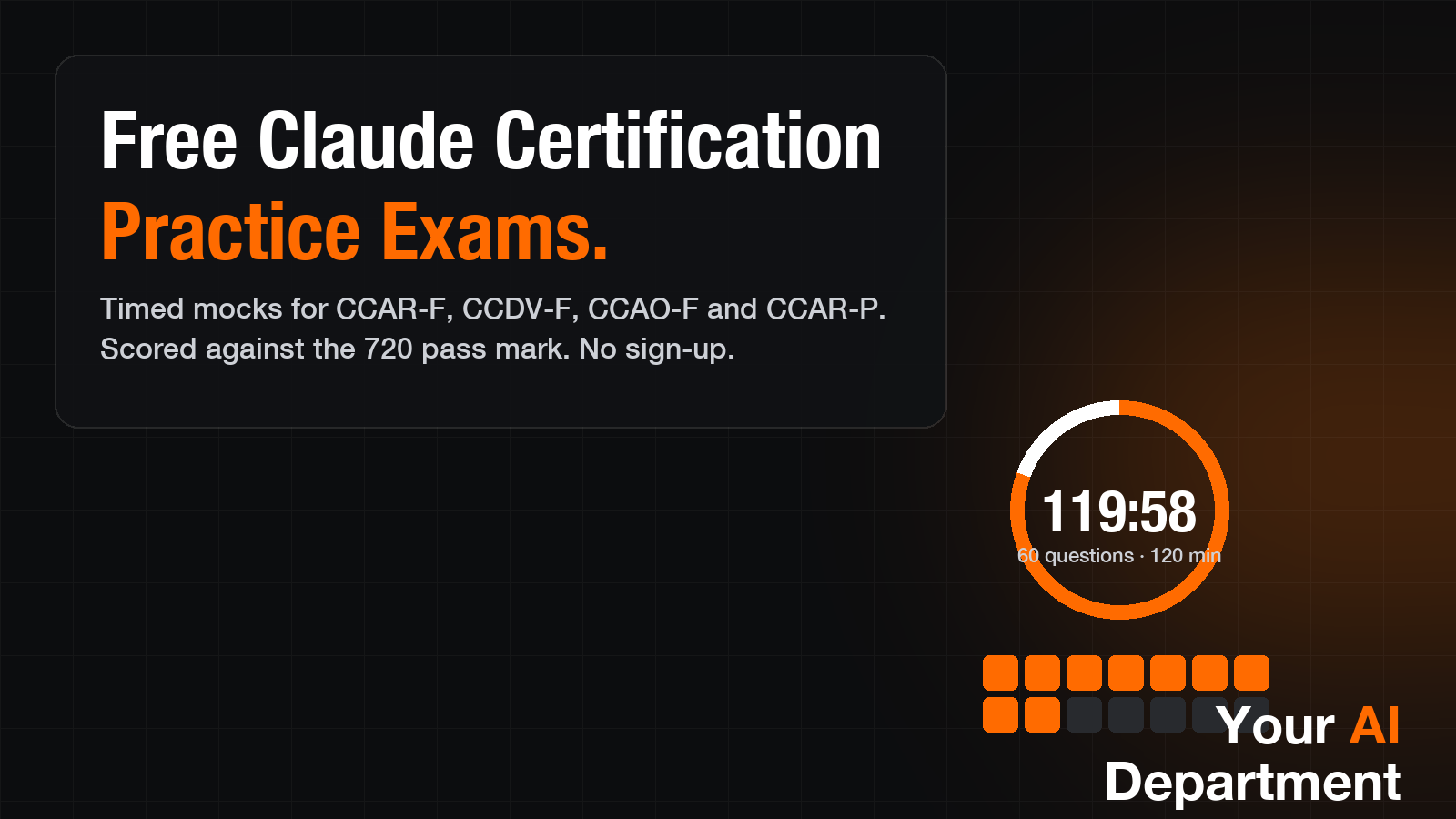
Every week someone in the network asks the same two things about the Claude exams: how hard is it, and how do I know I am ready. The honest answer to both was a shrug, because the only way to find out was to pay the fee and sit it.
So we built the thing we wanted our own members to have: a free timed practice exam for each of the four certifications, built the way the real exam is built.
What you get
Pick an exam, start the clock. The mock draws questions in proportion to the exam guide's domain weights, so agentic architecture is 27% of a CCAR-F attempt and applications are a third of a CCDV-F attempt, the same as the real thing. One question at a time, a countdown, flags, a navigator, and nothing revealed until you finish.
Finish and you get an estimated score on the 100 to 1,000 scale against the 720 pass mark. An email address then opens a bar per domain, a study plan that points you at your two or three weakest domains, and a full review with an explanation for every question. Your attempts are saved in your browser so you can see whether you are moving.
If two hours is too much for a first read, there is a 15-question quick check with no clock, and every exam has a practice-questions page where you can drill one domain at a time.
Why timed, and why domain-weighted
Most free practice material is a list of questions with the answers underneath. That teaches facts. It does not tell you whether you can do 60 scenario questions in 120 minutes with nothing to look up, which is the actual skill the exam tests.
Weighting matters for the same reason. If you prepare as if the five CCAR-F domains were equal, you spend a fifth of your time on a domain worth 15% and a fifth on one worth 27%. The mock's draw follows the guide, so your score by domain means something.
How the score works, and what it is not
Anthropic has not published how the real exam scales raw marks onto 100 to 1,000. We map percent correct linearly and say so on the results screen. Treat the number as a direction, not a prediction. A full attempt above the 720 equivalent with no domain far behind is the signal we tell members to book on.
None of the questions are exam content. They are original scenarios written from the published blueprints and Anthropic's public documentation, by the people at YAID who help members prepare. Sites that sell real exam questions are selling leaked material, and using it can cost you the credential.
How to use them
Take the quick check first to find the weak domains. Read the domain notes on the exam page, drill that domain on the practice-questions page, then sit the full timed exam on a different day. Repeat until the score holds. Then register, which for most independent engineers means joining a partner firm, since Anthropic opens the exams to Claude Partner Network organizations rather than individuals.
Start here: the practice exams hub. If you want to see how ours compare with the other practice sites, we listed twelve of them, ours included.
What is next
The banks will keep growing, CCAR-F first. If you find a question you think is wrong, email contact@youraidept.com with the question text and we will fix it the same day. And if you pass, tell us: real results from real members are the one thing no practice site can fake.
Take the free practice examRelated Insights

You Can't Just Sign Up for Claude Certification. Here's How Access Works.
There is no individual enrollment for Anthropic's Claude certifications. The three routes to exam eligibility, what each costs, and who owns the credential.
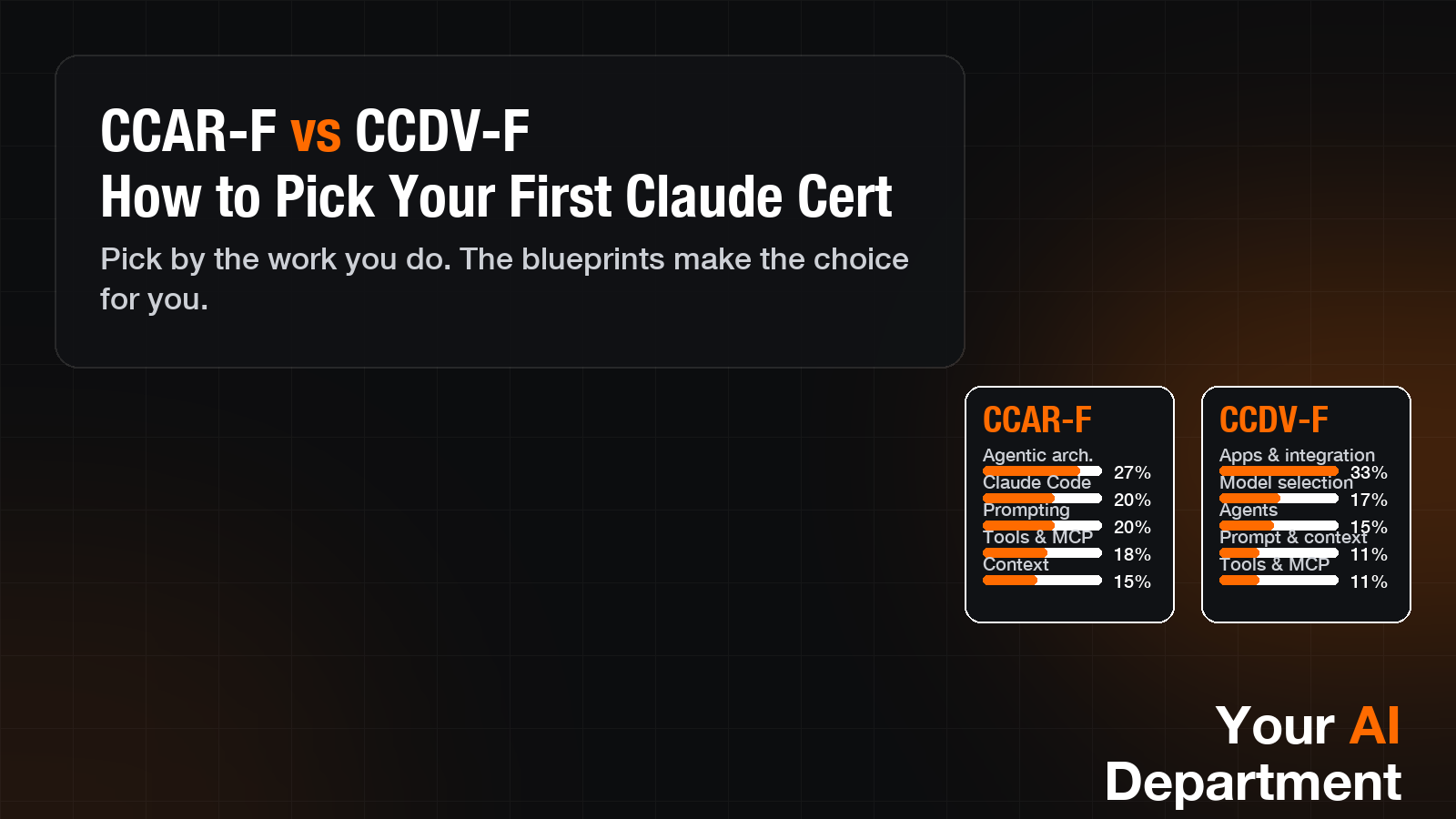
CCAR-F vs CCDV-F: How to Pick Your First Claude Certification
CCDV-F tests hands-on building; CCAR-F tests system design. The domain weights, the target candidates, and a simple rule for choosing which Claude exam to sit first.
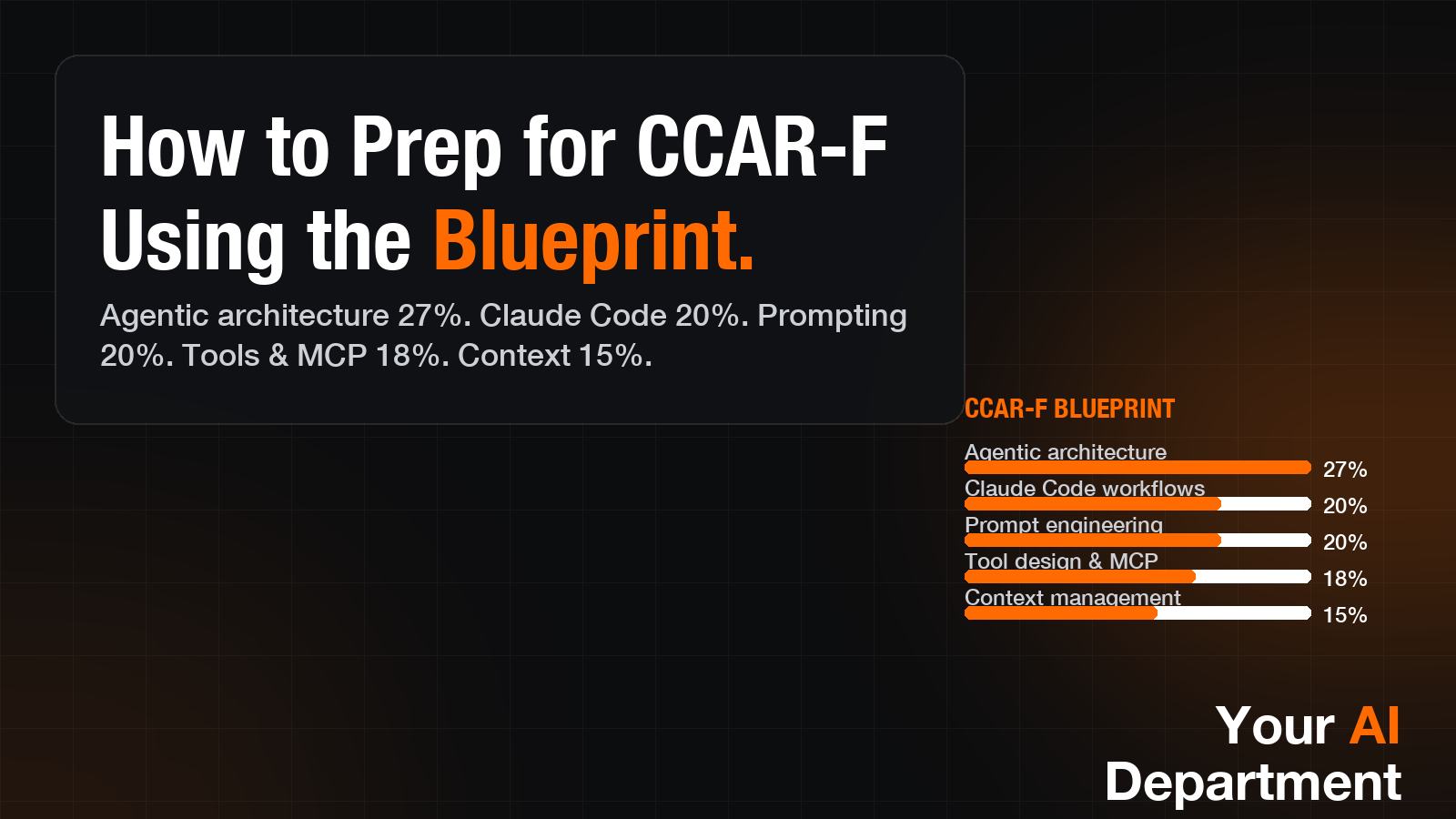
How to Prep for CCAR-F Using the Blueprint Instead of Vibes
The CCAR-F blueprint is public: agentic architecture 27%, Claude Code 20%, prompt engineering 20%, tools and MCP 18%, context management 15%. A three-week plan built around those weights.