

Pick by the work you do. Architect sounds more senior than Developer, people choose on that basis, and then they sit an exam built for someone else's job.
Anthropic publishes the blueprint for both exams, with domain weights. Read them side by side and the choice usually makes itself.
What CCDV-F tests
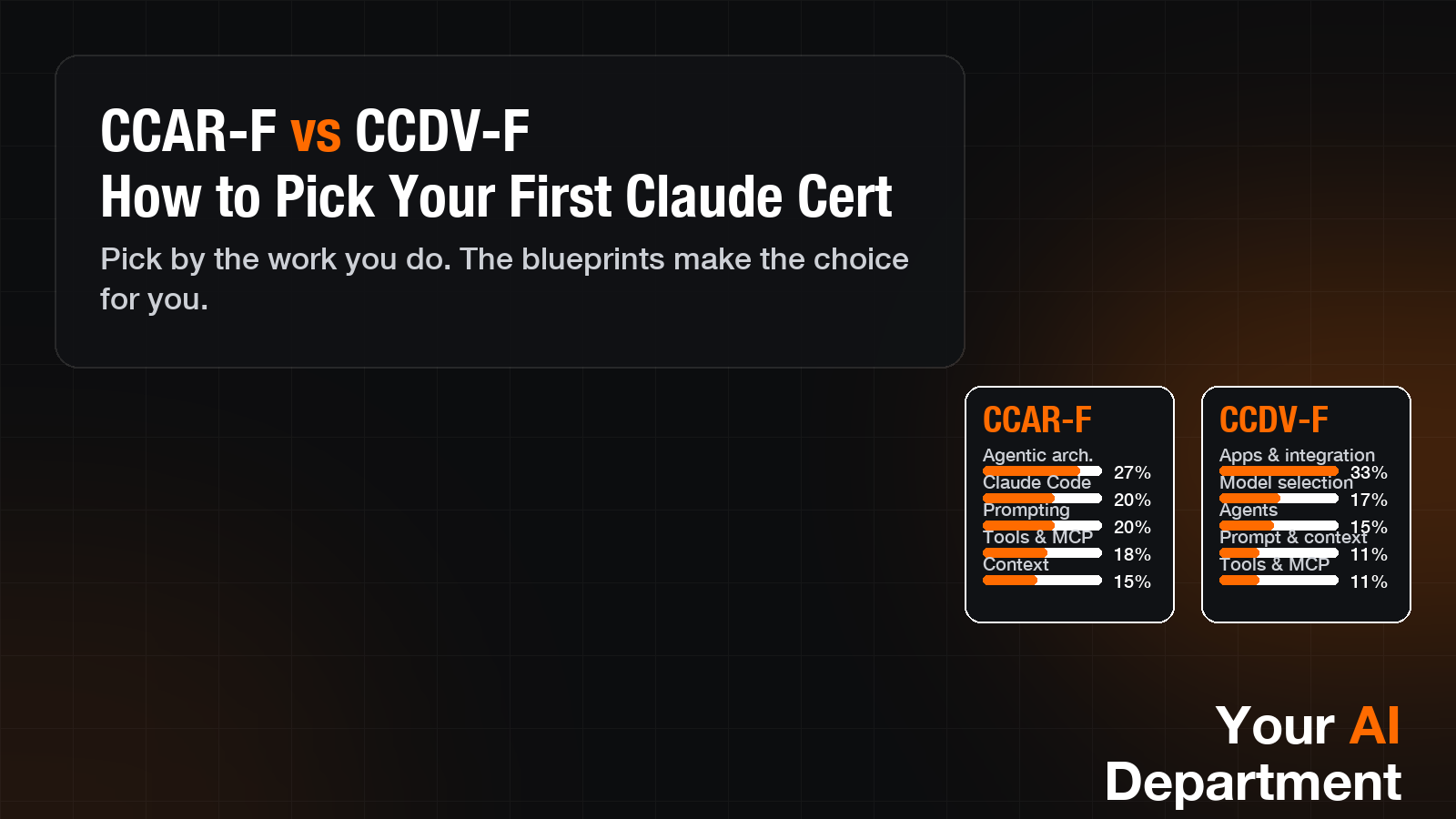
CCDV-F, Claude Certified Developer – Foundations, tests hands-on building. A third of the exam (33.1%) is applications and integration. Model selection and optimization is 16.8%, agents and workflows 14.7%, prompt and context engineering 11%, tools and MCP 10.6%, security and safety 8.1%. Claude Code and evaluation together are under 6%.
The exam guide describes its target candidate precisely: an engineer with one to five years of experience, at least six months hands-on with Claude or comparable LLM systems, comfortable in Python or TypeScript, fluent with REST APIs and CLI tools. 53 questions in 120 minutes.
If that profile reads like your last six months, this is your exam.
What CCAR-F tests
CCAR-F, Claude Certified Architect – Foundations, tests system design. Agentic architecture is 27%, Claude Code workflows 20%, prompt engineering 20%, tool design and MCP 18%, context management 15%. 60 questions in 120 minutes.
This is the exam people mean when they say CCA-F. The blueprint is about deciding how a Claude system should be put together: when a workflow with fixed control flow is enough and when you need an agent, how to scope tools, how to manage context over a long task. The code is assumed. The judgment is what gets tested.
What is the same on both
Both are proctored and closed-book with no AI assistance, delivered by Pearson VUE online or at a test center. Both cost $125 per attempt per the current exam guides. Both score on a 100 to 1,000 scale with 720 to pass, allow 4 attempts per rolling 12 months, and stay valid for 12 months with free on-time renewal.
Both require affiliation with a Claude Partner Network organization to register. There is no individual enrollment; we wrote up how access works separately.
How I'd decide
If you spend your days in the code shipping Claude features, sit CCDV-F. The exam rewards people who have deployed against the API, handled every stop reason, and paid a caching bill.
If you design systems, scope client work, or have to defend architecture decisions to other people, sit CCAR-F.
If you sell AI implementation work independently, CCAR-F first. It is the credential buyers recognize, and the prep maps onto what clients ask in sales conversations: what the agent can do on its own, what needs a human gate, what it costs to run.
Taking both
Nothing stops you taking both. The blueprints overlap by roughly a third, mostly on prompting, tools, and MCP, so the second exam is cheaper to prep than the first. Sit the one that matches your work now and add the other when a client or a job posting asks for it. If you want a reading before you choose, the free timed practice exams cover both.
Whichever you pick, you need a partner organization to register. Apply to YAID and sit either exam under our partner standing, or read the exam-by-exam breakdown in our certification guide.
Get exam-eligible through YAIDRelated Insights

You Can't Just Sign Up for Claude Certification. Here's How Access Works.
There is no individual enrollment for Anthropic's Claude certifications. The three routes to exam eligibility, what each costs, and who owns the credential.
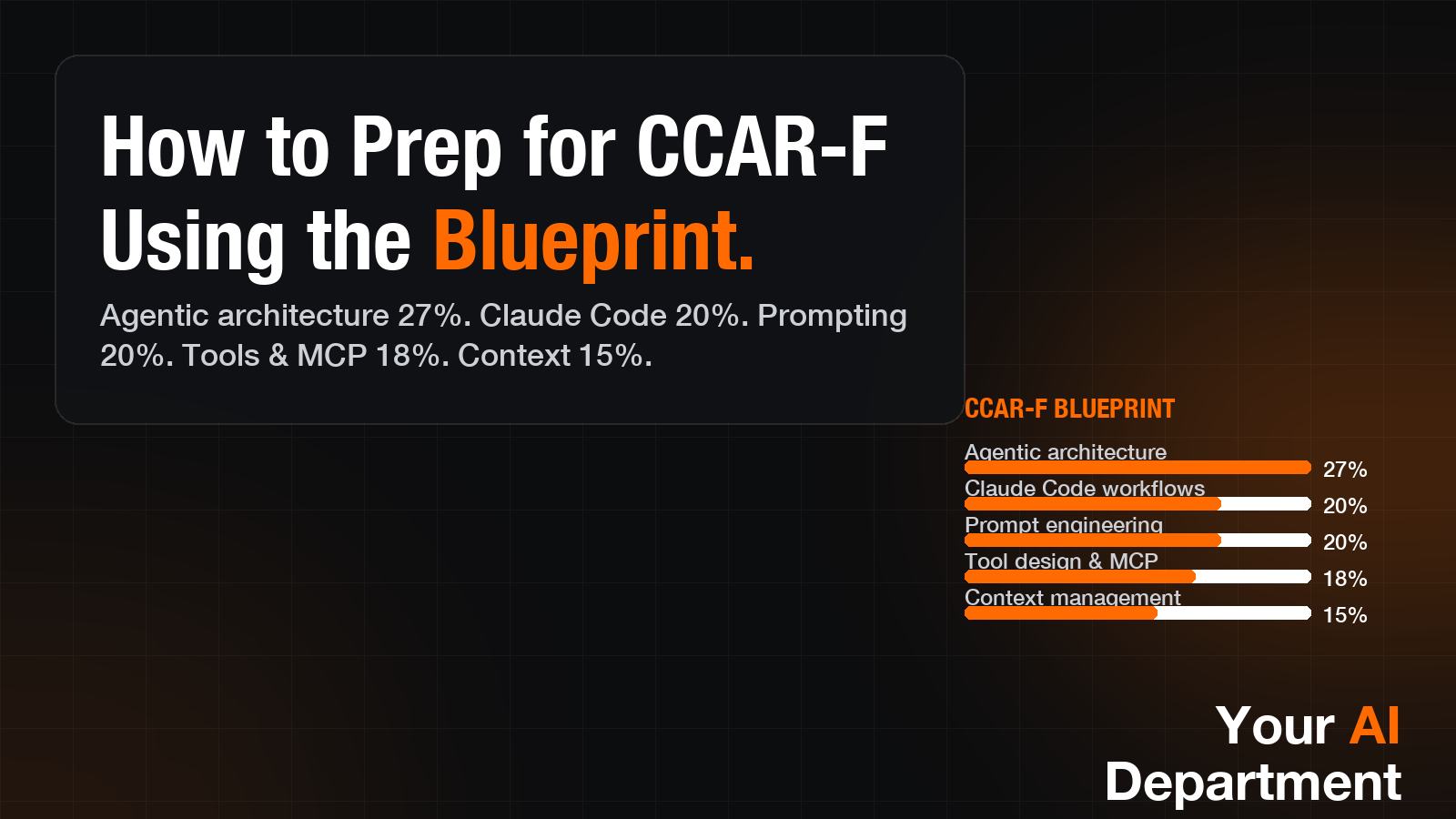
How to Prep for CCAR-F Using the Blueprint Instead of Vibes
The CCAR-F blueprint is public: agentic architecture 27%, Claude Code 20%, prompt engineering 20%, tools and MCP 18%, context management 15%. A three-week plan built around those weights.

Claude Certifications Expire After 12 Months. Renewal Is Free Only If You're On Time.
Anthropic's Claude certifications are valid for 12 months. Renew on time and it is a free, non-proctored assessment. Let it lapse and you sit the full proctored exam again at the standard fee.