Automations vs Agents (And Why It Matters)

Michael Greenberg
Co-Founder & AI Product Lead
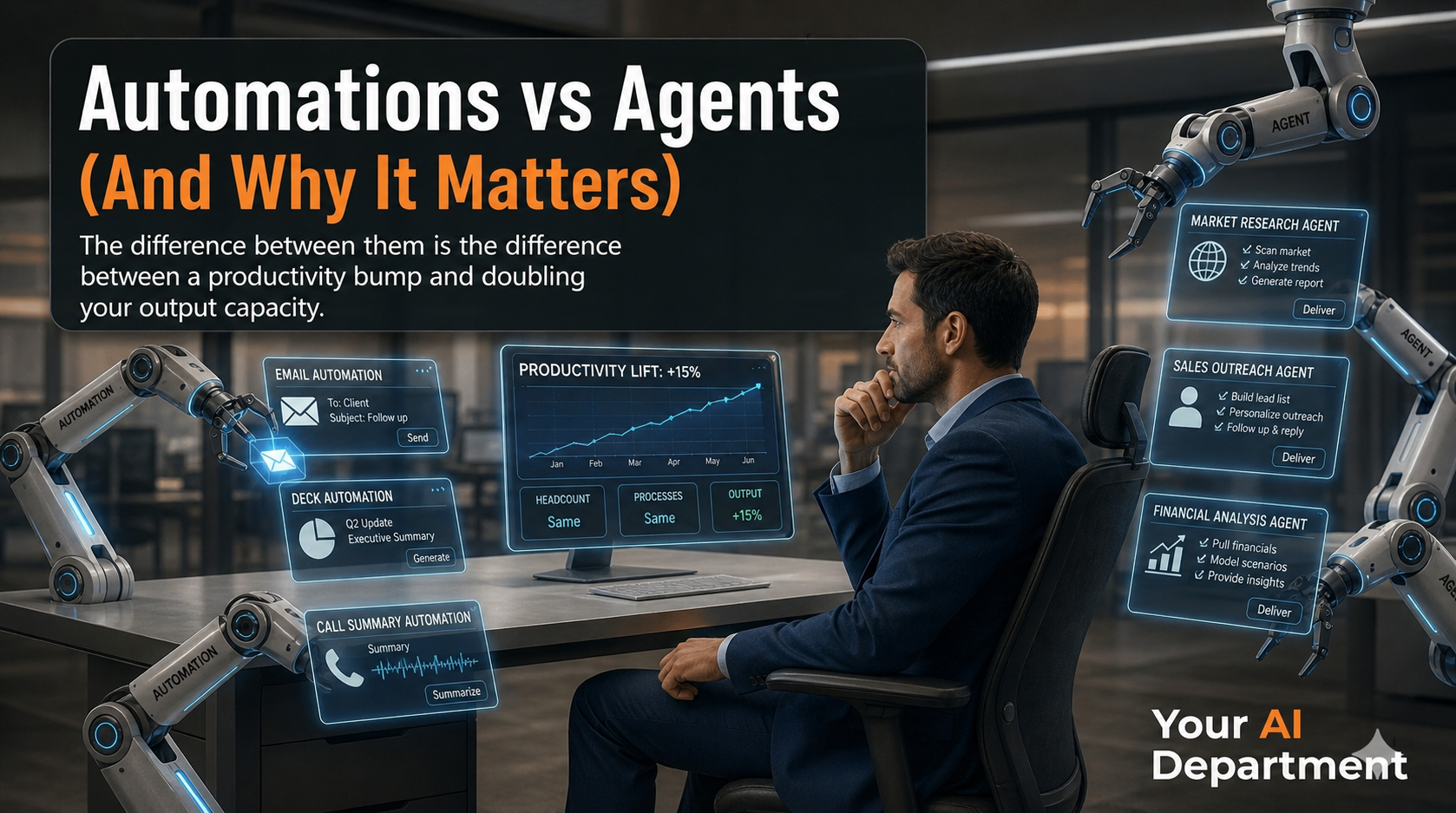
You bought ChatGPT licenses for the team last year. Productivity went up 15%. The business is the same size.
People are writing emails faster. Drafting decks in half the time. Summarizing calls before they hit your inbox. Same headcount, same processes, marginally more efficient people.
That's because most CEOs don't separate two very different things: automations and agents. The difference between them is the difference between a productivity bump and doubling your output capacity.
Automations: A Fixed Path
An automation is a fixed path. Same input in, same output out. A trigger fires a sequence, and the sequence runs the same way every time.
Here's a concrete one. A claim hits seven days old in your system. The automation pulls the customer name from your CRM, grabs the ticket data, drafts a follow-up, sends it through Twilio, and waits for a response before moving to the next step. No judgment calls. No deviation. Just a sequence.
Automations are the low-hanging fruit at any $50M+ company. The status update emails. The data entry across three systems. The Monday morning report nobody reads. They eat 4-6 hours a week per person and don't require thinking.
Automations make existing work faster. That's it. They're where you should start, but they cap at the same 15% gain that shows up in employee testimonials and never changes the headcount math.
Agents: A Judgment Engine
An agent is different. It reasons through ambiguity that would crash a deterministic workflow.
Take scheduling for a $200M field services business. W-2 employees, 1099 contractors, regions with shifting availability, contractors working for two other companies, a 24-hour SLA from the carrier client that doesn't care if 5,000 new claims got dropped on you overnight. That's not a workflow. That's a judgment problem with too many variables for any script.
An agent works through it the way an experienced dispatcher would. It pulls context from the CRM, the dispatch software, the contractor portal. It weighs tradeoffs. It makes the call. Except it doesn't go home at 6pm and doesn't take three months to ramp.
This is where the 2x happens. A team of five now handles what used to require ten. Capacity changes. The relationship between revenue growth and headcount stops being linear.
The Linear Ceiling
Here's the exercise we run with CEOs. If you doubled your revenue this year without changing how you operate, what breaks first?
The answer is almost always a function where growth requires proportional headcount. Double the inbound, double the SDRs. Double the deal volume, double the ops team. Double the customers, double support. Every doubling adds friction, coordination overhead, and onboarding burden.
Automations sand down the friction. Agents break the relationship.
Why Sequence Matters
Most CEOs we talk to want to start with the agent-level project. It's the exciting one. It promises the biggest ROI.
It usually fails. The technology can do it. The company doesn't have the institutional muscle yet. Nobody trusts AI outputs. There are no operational habits for maintaining or improving these systems. The first failure becomes the reason to give up.
Start with two or three automations. Boring ones are fine, even ideal. The point is to build trust and habit inside the company before you ask the org to absorb something harder. Then go after the agent.
What To Do This Week
Ask your COO or CFO one question: If we doubled revenue tomorrow, which team breaks first?
That answer is your linear ceiling. That's where the agent goes. Don't build it yet. But know where you're heading before you spend money automating things that don't change the math.
Automations are your proof of concept. Agents are how the math changes.
Ready to Identify Your Linear Ceiling?Share this analysis
Related Insights
What We Told 190 CEOs About AI Last Week
AI failure is a context problem, not a tech problem - most companies are stuck using AI as "grease" instead of building proper "cogs" that replace ...

Stop Buying "AI Grease." Start Building Cogs.
Most AI projects are "Grease" (10% faster humans) not "Cogs" (10x structural change) — and Grease actively makes future transformation harder •The ...
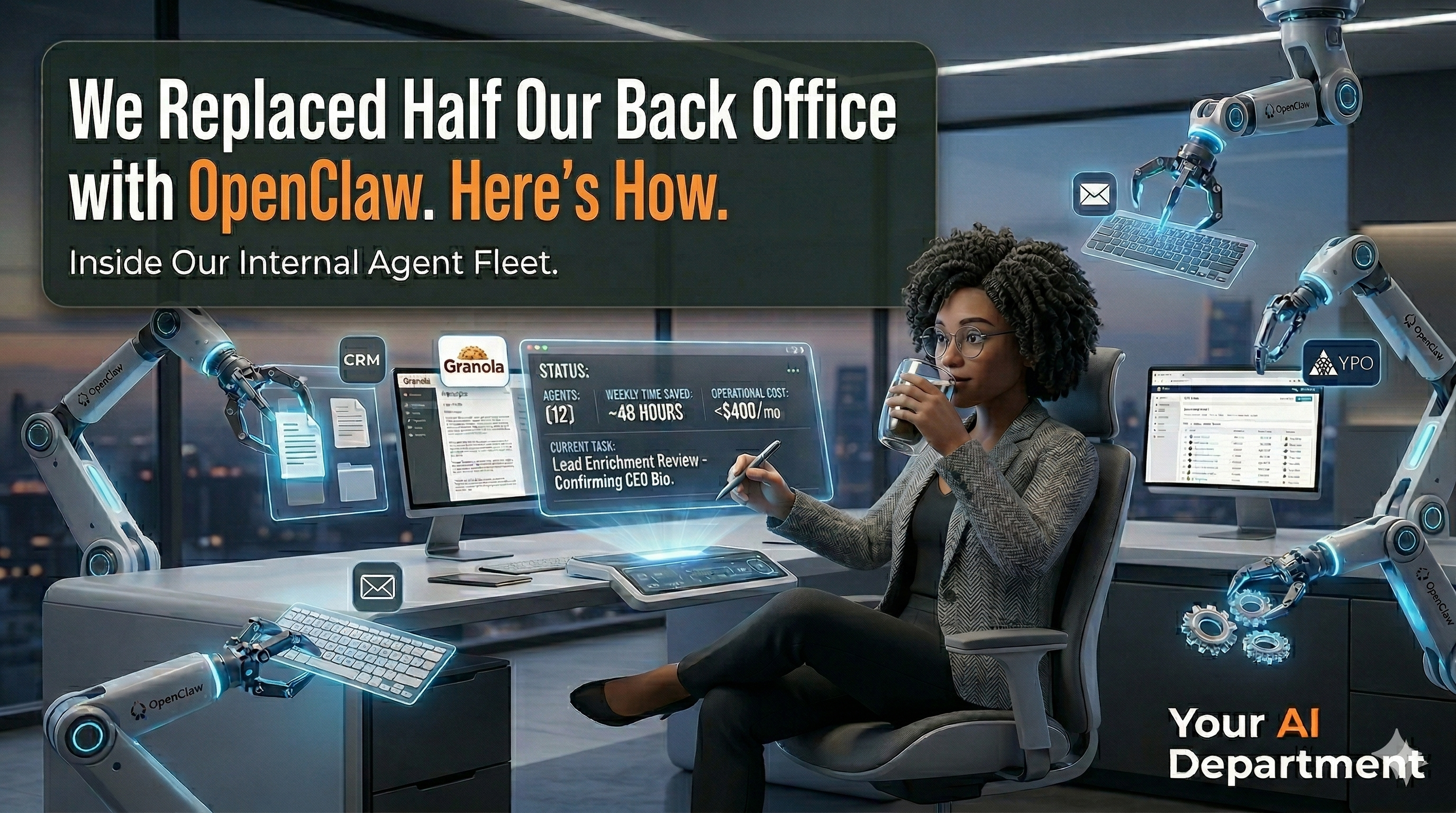
We Replaced Half Our Back Office with OpenClaw. Here's How.
We replaced 40-50 hours per week of manual work with a dozen autonomous agents running on OpenClaw, costing under $700/month total infrastructure• ...