
You Bought the Wrong Kind of AI
You rolled out ChatGPT to the team. Usage spiked for two weeks. Most people went back to doing their jobs the same way.
The KPIs you care about didn't move.
This isn't because AI doesn't work. It's because you bought the wrong kind.
The Two Buckets
Every AI modernization project falls into one of two categories. This is how you should decide what to build and what to skip.
Grease makes a human faster at their existing job. Your support rep still reads the ticket, still looks up the order, still types the response. She has ChatGPT which drafts a reply she can edit. She's 10% faster. She still touches every ticket.
A Cog replaces the workflow entirely. The ticket arrives. An AI agent reads it, checks order status in your ERP, identifies it's a "where's my shipment?" request, pulls the tracking number, and sends the response. Your support rep never saw it. She's handling the 20% of tickets that require judgment — the angry customer, the unusual return, the edge case.
That's not a 10% improvement. That's a 10x structural change.
Grease is a feature. A Cog is an asset.
Features depreciate. Assets compound.
Why You Default to Grease
Grease is easy. You buy ChatGPT licenses. People get a tool. If it doesn't work, you cancel the subscription. Low risk.
But Grease doesn't change the machine. Same headcount. Same bottlenecks. Same capacity constraints. When volume doubles, you still need to hire.
We've watched this in several $50M+ companies over the last year. The CEO bought AI tools expecting transformation. What they got was a slightly faster version of the status quo — at $40K/year in subscriptions.
Worse: Grease trains your team to think of AI as "that thing that helps me write emails faster." When you come back with a real Cog project — one that changes the structure of work — they resist. Because the first experience set the ceiling.
Grease doesn't just fail to transform. It makes transformation harder.
The Diagnostic
For any process you're thinking about applying AI to, ask one question:
"Does this task follow the same steps every time, or does it require human judgment every time?"
Same steps, same order, same logic, every time? Cog. Give it to an AI Agent.
The human's experience and intuition change the outcome each time? Grease is good here.
Your morning ops report — Cog. Invoice reconciliation — Cog. Standard RFP responses — Cog.
Negotiating a supplier contract — not a Cog. Deciding whether to extend credit to a borderline account — not a Cog. Coaching an underperforming team member — not a Cog.
The trap: companies buy Grease for Cog-ready processes. The CEO says "use AI in customer support." The team buys ChatGPT seats. Meanwhile, 70% of support tickets follow an identical resolution path that could run without a human.
Where Most Companies Go Wrong
They scope AI at the department level. "Automate procurement." "Use AI in finance."
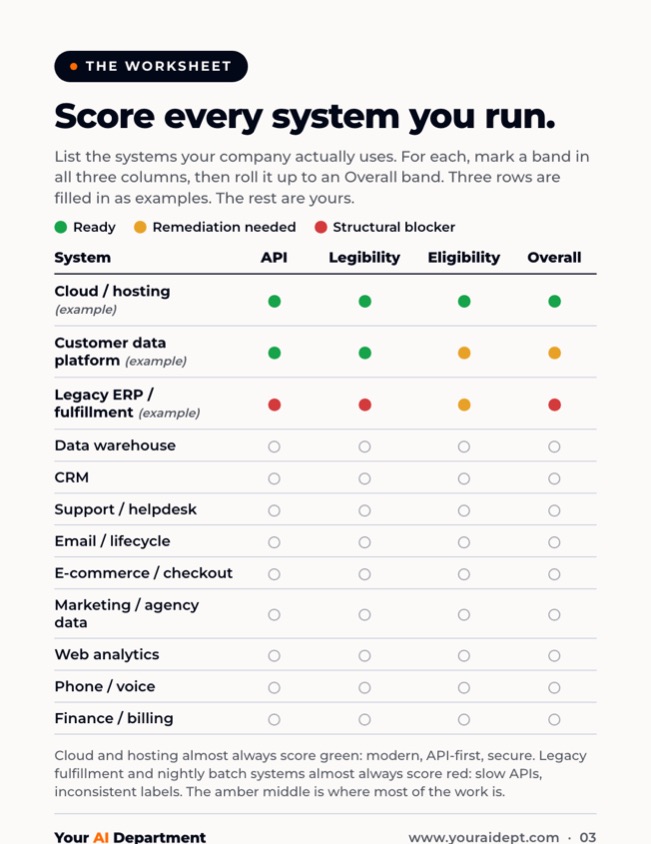
AI doesn't automate departments. It automates actions which make up a department.
Take Sarah in procurement. She spends 90 minutes every morning copying data from three vendor portals into a spreadsheet so she can identify which shipments are delayed. The identification — the thinking part — takes 4 minutes. The other 86 minutes is data gathering that happens the same way every day.
Sarah isn't expensive because she's smart. She's expensive because she's doing robot work at human rates.
The 86 minutes is a Cog. The 4 minutes is why you hired her.
The way to find these is to break work down to its smallest trigger-action pair. Not "automate AP" — that's a wish. Instead: "when an invoice PDF arrives in this inbox, extract line items, match them against the open PO in NetSuite, flag any variance over 2%."
That's a buildable instruction.
What To Do This Week
Pick the department that complains the most about manual work. Sit with one person. Ask them to walk you through the first two hours of their day.
Write down every task as: "When X happens, I do Y."
Circle the ones where Y is the same every time. No judgment. No context changes.
That's your Cog candidate list.
The Bottom Line
The companies pulling ahead aren't the ones with the most AI tools. They're the ones who replaced the processes with AI agents.
Share this analysis
Related Insights
10 AI Automations Your Competitors Deployed Last Quarter
"Grease" makes your team 10% faster. "Cogs" replace workflows entirely—running 24/7 without human prompting. • Below: 10 autonomous AI automations ...
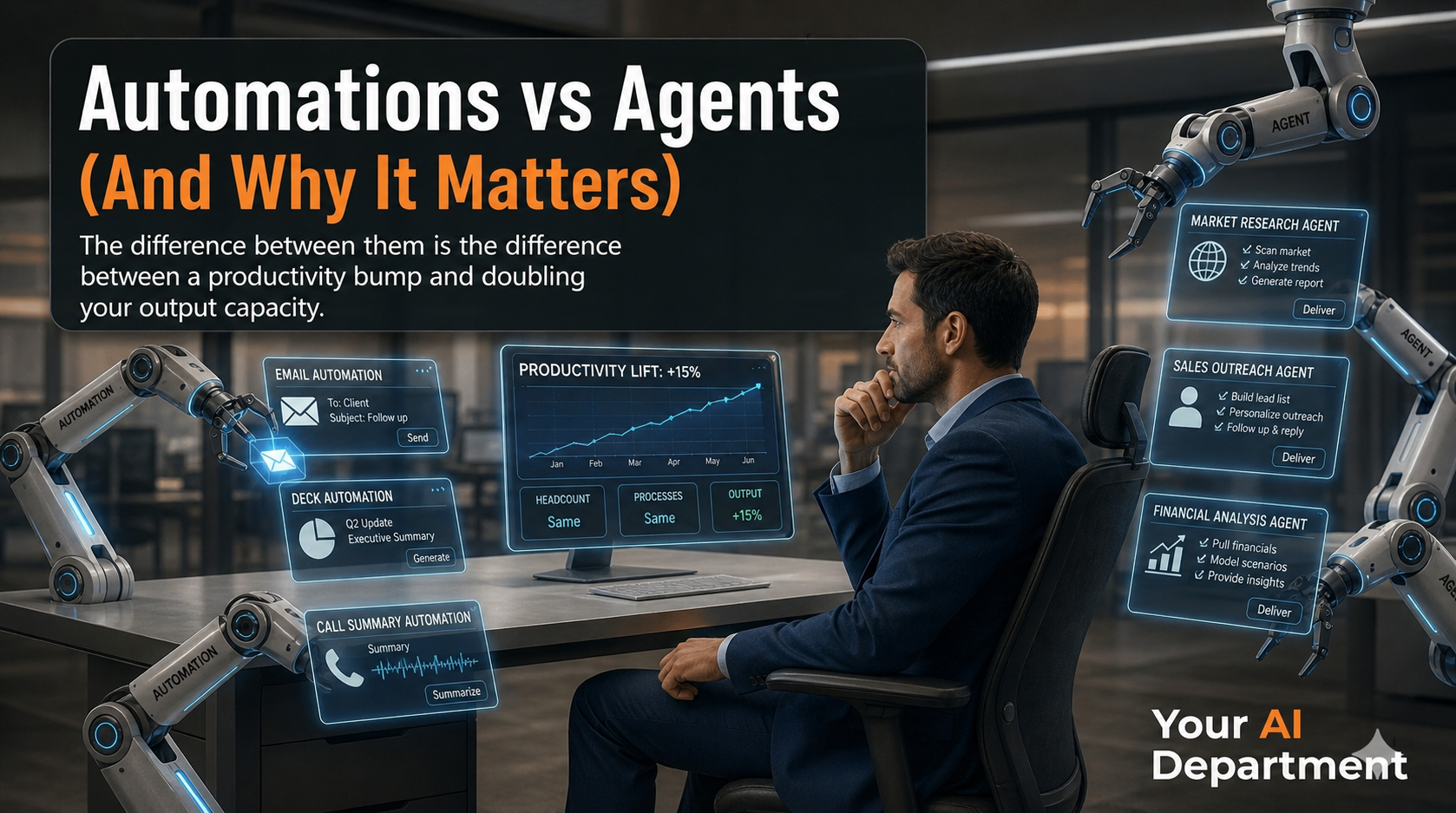
Automations vs Agents (And Why It Matters)
Automations follow fixed paths and boost productivity by 15%, but don't change your headcount math• AI agents make judgment calls in complex scenar...
What We Told 190 CEOs About AI Last Week
AI failure is a context problem, not a tech problem - most companies are stuck using AI as "grease" instead of building proper "cogs" that replace ...