The Bottom Line
A data warehouse isn't a tech upgrade—it's giving your business a memory that compounds, so every decision builds on every previous one.
Most CEOs think their data is "ready" because it's digital. Digital doesn't mean usable. A PDF of last quarter's financials is a screenshot, not an asset.
The companies acquiring faster, staffing smarter, and deploying AI aren't more innovative—they have structured access to everything they've ever done.
You Probably Taught Yourself SQL
Not literally. But you've done your version of it.
At some point, the reports your systems gave you stopped being enough. No single report—from your ERP, your CRM, your project management tool—gave you what you actually needed. So you started pulling data yourself. A spreadsheet you maintain by hand.
You became the human data warehouse.
We had a conversation recently with a CEO running a $50M+ specialty construction company. She taught herself SQL because "no one report gave me what I needed." She was bypassing her own ERP's interface—writing queries directly against the database to answer basic operational questions.
She's not unusual. She's the pattern.
The thing every CEO in this position has in common: you've solved the data problem with your own time.
That works—until you want AI to do the reasoning for you.
Until you want to acquire a company and integrate their data in weeks.
Until you realize the institutional knowledge in your head should be compounding in a system, not disappearing when you're on a plane.
What a Data Warehouse Actually Is
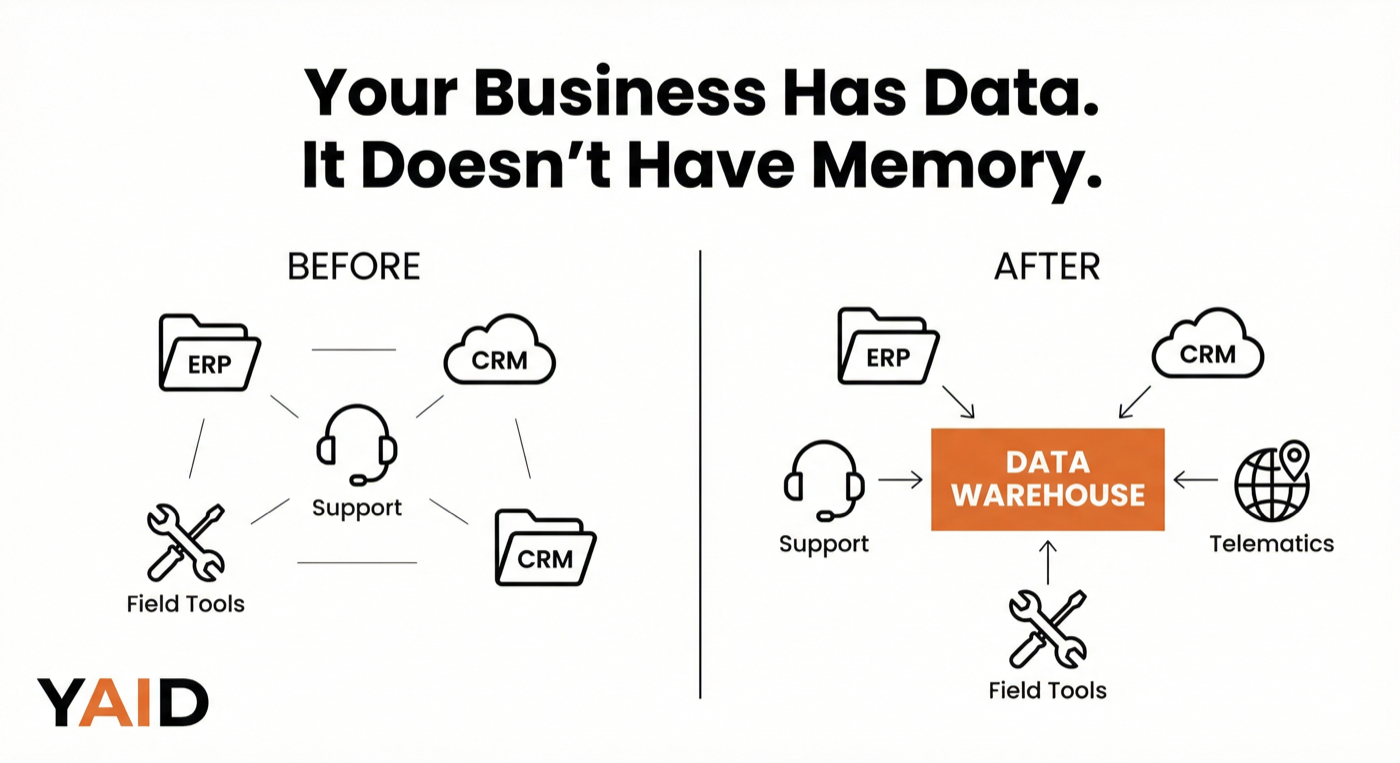
Your business data lives in six or seven systems. Your ERP and CRM knows your customers and what they've paid. Your field tools know what happened on each job. Your telematics knows where your equipment is. Your HR system knows who's available.
None of them talk to each other.
So when you ask a question that crosses two systems—"Which crews had the fewest delays on our top 10 accounts last quarter?"—a human pulls data from multiple places, reconciles it in a spreadsheet, and gives you an answer 48 hours later.
A data warehouse reconciles all of that automatically. Every night, your data from every system is cleaned, labeled consistently, and stitched together. That same question gets answered in seconds—by a person, or by an AI agent doing it at 6am before you wake up.
It's not a backup. It's not a dashboard. It's the difference between your business having data and your business remembering everything it's ever done.
The Misconception That Costs You Six Months
Most CEOs assume they don't need a data warehouse beacuse they have access to dashboards and reports in Salesforce, Hubspot or anyother tool they're using.
It's not the same. Data warehouse work is in what we call "data accounting."
Your ERP calls a project "Job #4521." Your field tool calls the same project "Riverside Solar Phase 2." Your invoicing system calls it "RS-P2." A human knows these are the same thing (with a lot of mental burden). AI can't read this and act within its context limitations.
That translation layer is the data warehouse. For a company with one primary ERP and a handful of secondary systems, expect $60,000–$80,000 to build, three months, minimal ongoing hosting costs. Not a science project. Standard infrastructure that predates AI by a decade.
Why It Matters More Now
For the last ten years, a data warehouse gave you better dashboards. Now it gives you better decisions.
You can point ChatGPT or Claude directly at a structured data warehouse and query your entire business in plain English. No SQL. No report builder. No waiting.
And it goes further. With your data structured, you can deploy AI agents that act: they check time cards against telematics every morning, flagging payment pattern shifts before your AR team notices, pre-building next week's resource plan from historical data. While you sleep.
None of that works if your data is scattered across systems that don't talk to each other. All of it becomes possible once it's in one place.
What To Do This Week
If you have one, ask your CTO or IT lead one question:
"If I gave an AI access to our data today, could it answer the same questions our best analyst answers?"
If the answer is no, this is why your AI deployments aren't meeting expectations.
If you don't have a data warehouse and are doing $15M+ in revenue, you need a data warehouse more than you think.
Your business has data. Without structuring it, your business doesn't have memory.
Book Your Free Data Strategy ConsultationShare this analysis
Related Insights
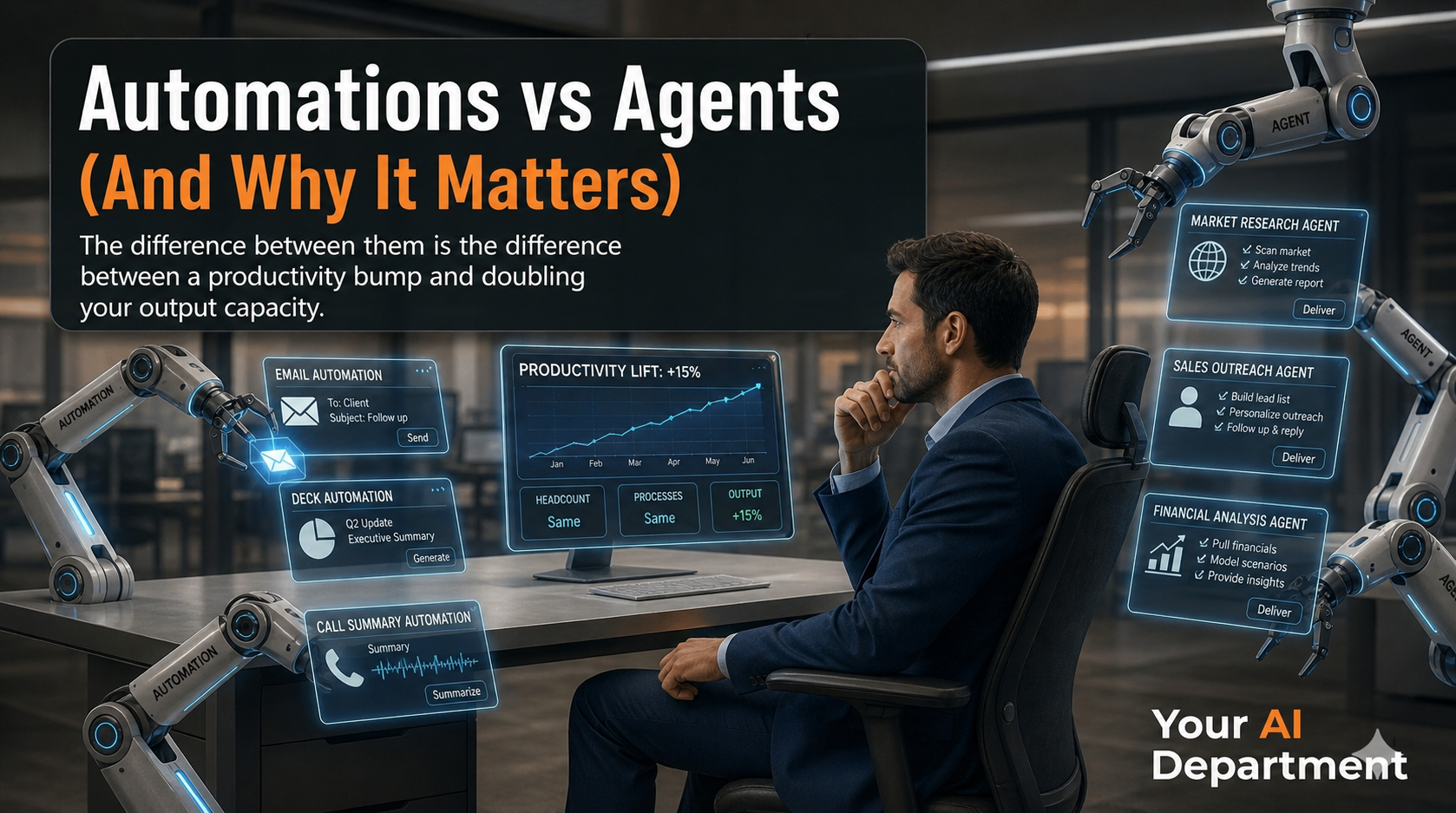
Automations vs Agents (And Why It Matters)
Automations follow fixed paths and boost productivity by 15%, but don't change your headcount math• AI agents make judgment calls in complex scenar...
10 AI Automations Your Competitors Deployed Last Quarter
"Grease" makes your team 10% faster. "Cogs" replace workflows entirely—running 24/7 without human prompting. • Below: 10 autonomous AI automations ...
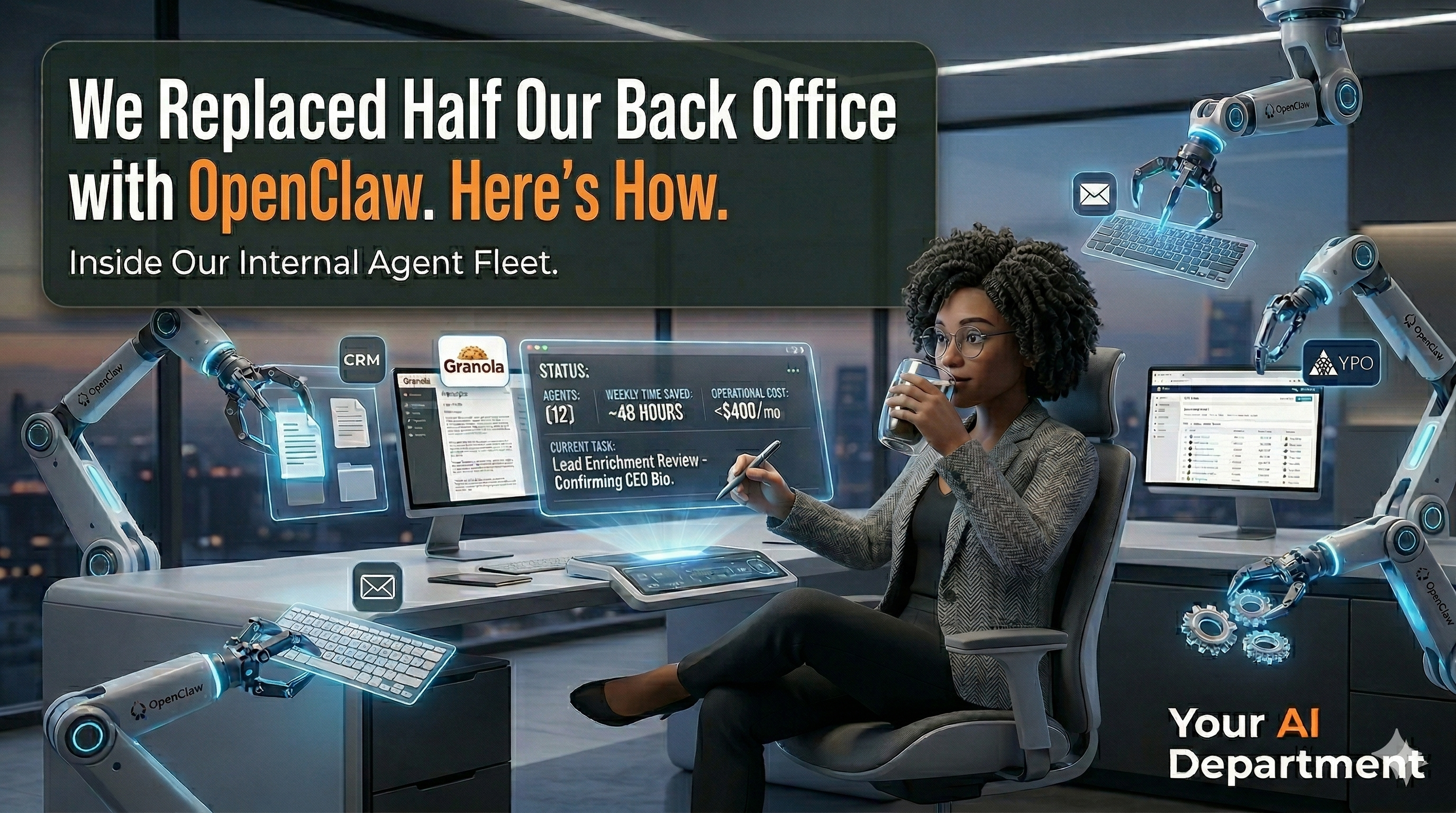
We Replaced Half Our Back Office with OpenClaw. Here's How.
We replaced 40-50 hours per week of manual work with a dozen autonomous agents running on OpenClaw, costing under $700/month total infrastructure• ...