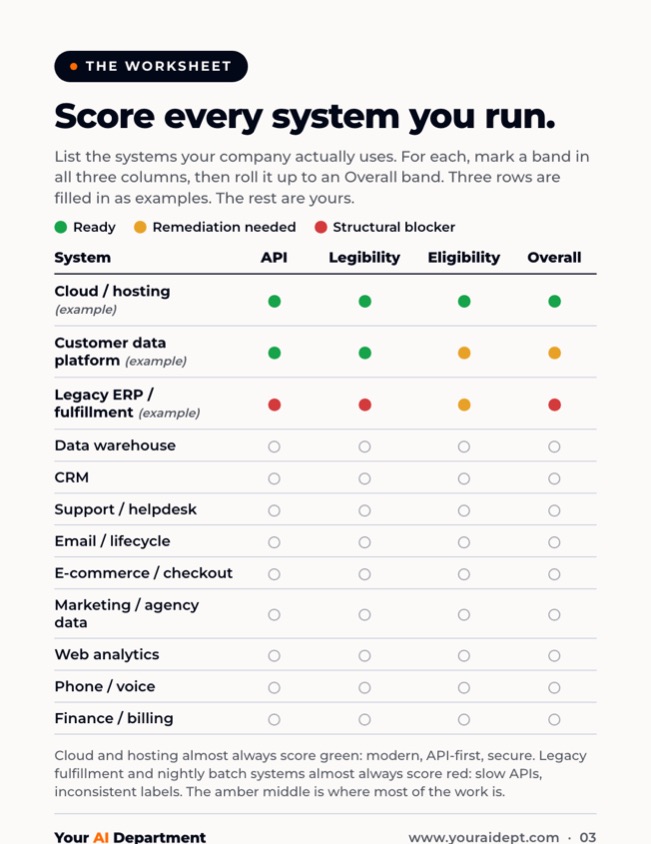
We Replaced Half Our Back Office with OpenClaw. Here's How.

Michael Greenberg
Co-Founder & AI Product Lead
The Bottom Line
We run a dozen autonomous agents across prospecting, CRM, project management, content, and client delivery. What used to take a team of 10 now only takes 2. Each agent replaced a workflow, not sped up a person. If you've been following along with our frameworks, these are sets of cogs.
The core stack is OpenClaw + Claude + connected tools (ActiveCampaign, Granola, LinkedIn, Slack, Apollo, Google Drive, Attio). Total infrastructure cost: under $400/month.
If you claim to be an AI company but you still have humans copy-pasting between systems, you're lying about being an AI company, and you know it.
The Consulting Firm That Eats Its Own Cooking
Last week we wrote about OpenClaw and why every CEO needs to think about autonomous agents before deploying them. The data audit. The classification layer. The security hardening.
This week we're showing our hand.
We tell $50M+ companies to replace workflows with agents. If we weren't doing the same thing internally, we'd be hypocrites. So here's what's running inside Your AI Dept right now, what it replaced, and what it costs.
Every agent below is a Cog. Not a ChatGPT subscription that makes someone 10% faster. A system that runs a process end-to-end without a human in the loop until a decision is required.
We call the shift this creates Authors to Editors. Our team stopped writing reports, drafting proposals, and compiling research from scratch. Now they review, refine, and decide. The grind shrank. The judgment part grew.
1. Prospecting: The Agent That Finds Who We Should Talk To
What it replaced: A human spending 6-8 hours per week scanning executive forums and LinkedIn for CEOs showing signals of AI readiness.
What it does now: An agent monitors executive community threads, LinkedIn activity, and news mentions for our target profile: CEOs in manufacturing, logistics, healthcare, and professional services who are asking about AI, posting about operational bottlenecks, or hiring technical roles for the first time.
Every Monday morning, a ranked list of 15-20 prospects lands in Slack with context: what they posted, what their company does, estimated revenue, and a suggested outreach angle. The agent writes the first draft of a personalized message. A human reviews and sends.
Immediate Value: About 7 hours/week of time saved, but the real gain is coverage. No one had to monitor those sources with a close eye.
2. Lead Enrichment: From Name to Full Profile in 90 Seconds
What it replaced: The 20-minute research scramble before every call. Pulling up LinkedIn, Googling the company, scanning recent news.
What it does now: The moment a lead enters our CRM, an agent enriches the record: company revenue, headcount, tech stack (pulled from job postings and public data), recent funding or acquisitions, and any AI-related activity. It also pulls the CEO's recent LinkedIn activity and public commentary.
By the time someone opens a lead record, it already contains a full dossier. No research tab-switching. No let me look them up real quick.
Michael used to spend 15-20 minutes prepping for every intro call. Now he spends 2 minutes reviewing what the agent compiled and clicks on source attribution to dive deeper if desired.
3. Meeting to Action Pipeline: Calls That Write Their Own Follow-Ups
What it replaced: The post-call ritual of writing notes, updating the CRM, drafting follow-up emails, and creating tasks. About 25 minutes of admin per 45-minute call.
What it does now: Granola records and transcribes every client call. An agent parses the transcript after the call ends. It extracts key decisions, action items with owners, objections raised, and next steps. It updates the deal record in Attio, drafts a follow-up email, and creates tasks.
Within 10 minutes of hanging up, the CRM is updated, the follow-up is sitting in drafts, and every task is assigned. The human reviews the email, adjusts tone if needed, and hits send.
What changed: We used to lose action items. Not because we forgot, but because the gap between I'll send that over and actually doing it was filled with three other calls. Now the gap doesn't exist.
4. Content Research: The Agent That Reads So We Don't Have To
What it replaced: Time spent scanning industry reports, competitor content, AI research, and executive forum threads for article ideas.
What it does now: An agent monitors 30+ sources daily: executive forum threads across 12 business networks, competitor content, AI research from Anthropic and OpenAI, industry publications in our four verticals, and mainly, client call transcripts via Granola. It surfaces a weekly brief: trending topics, questions CEOs are asking, content gaps we haven't covered, and specific data points worth referencing.
The Granola-mined Topics section of our content doc is almost entirely agent-populated now. A human decides what to write about and how to frame it. The agent handles the intake.
5. Proposal Generation: First Draft in 20 Minutes, Not 3 Days
What it replaced: The 8-12 hour process of writing a custom SOW from scratch for every engagement.
What it does now: After an intake call, an agent pulls the Granola transcript, extracts the client's stated problems, maps them to our service offerings, pulls comparable scopes from past engagements, and generates a first-draft SOW with estimated timelines and pricing tiers. It flags anything non-standard for human review.
A 70-80% complete SOW draft within 20 minutes of the call ending. A senior team member refines scope, adjusts pricing, and sends. What used to take 2-3 business days now takes an afternoon.
6. Competitive Intelligence: What Changed While You Slept
What it replaced: The ad-hoc someone check what Accenture and Deloitte are saying about AI this week that happened sporadically.
What it does now: An agent monitors competitor websites, LinkedIn company pages, job postings (which reveal strategic priorities), and press mentions. Weekly Slack digest: new service offerings, key hires, positioning shifts, client wins. It also monitors our clients' competitors for the same signals, feeding into pre-call briefs.
We stopped being surprised by competitor moves. And our clients get competitive context in every engagement without us billing research hours for it.
What This Looks Like in Total
Those are six of the dozen agents we run. OpenClaw as the orchestration layer, Claude as the reasoning engine. Under $400/month infrastructure plus about $300/month in Claude API usage, which scales with volume.
Combined, they replaced roughly 40-50 hours per week of human work. Not 40 hours of thinking. 40 hours of copying data between systems, formatting documents, scanning sources, and doing the setup work that used to eat the first two hours of every day.
Nobody got fired. The team went from authoring to editing. The grind shrank, and the judgment part grew.
Why We're Telling You This
Two reasons.
First, because the companies pulling ahead with AI aren't the ones with the biggest budgets. They're the ones that started actually using the tech. These agents didn't appear overnight. We built them one at a time over four months, each one solving a specific pain point that was already costing us time.
Second, because this is exactly what we build for clients. Every agent above follows the same architecture we deploy for $50M+ companies: data eligibility audit first, classification layer, sandboxed execution, human-in-the-loop where it matters. The difference is we tested it on ourselves before we sold it.
What To Do This Week
Pick the workflow in your company that generates the most copy-paste between systems. The one where someone spends 30+ minutes a day moving data from one tool to another. Write down the trigger, the inputs, the outputs, and where a human decision is actually required.
That's your first agent.
Book Your Free ConsultationThe Bottom Line
The companies pulling ahead aren't hiring more people. They're turning their best people into editors.
Share this analysis
Related Insights
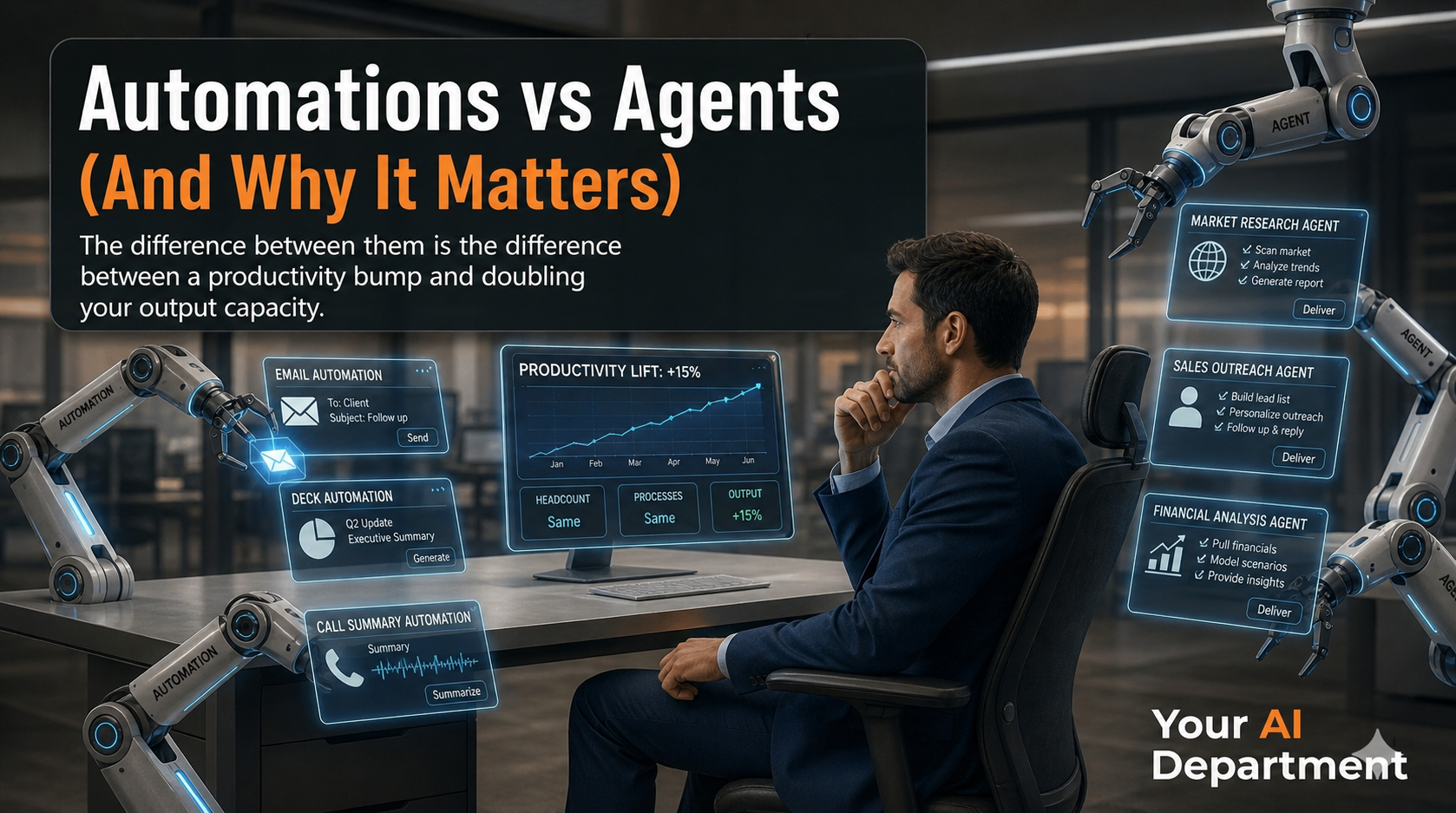
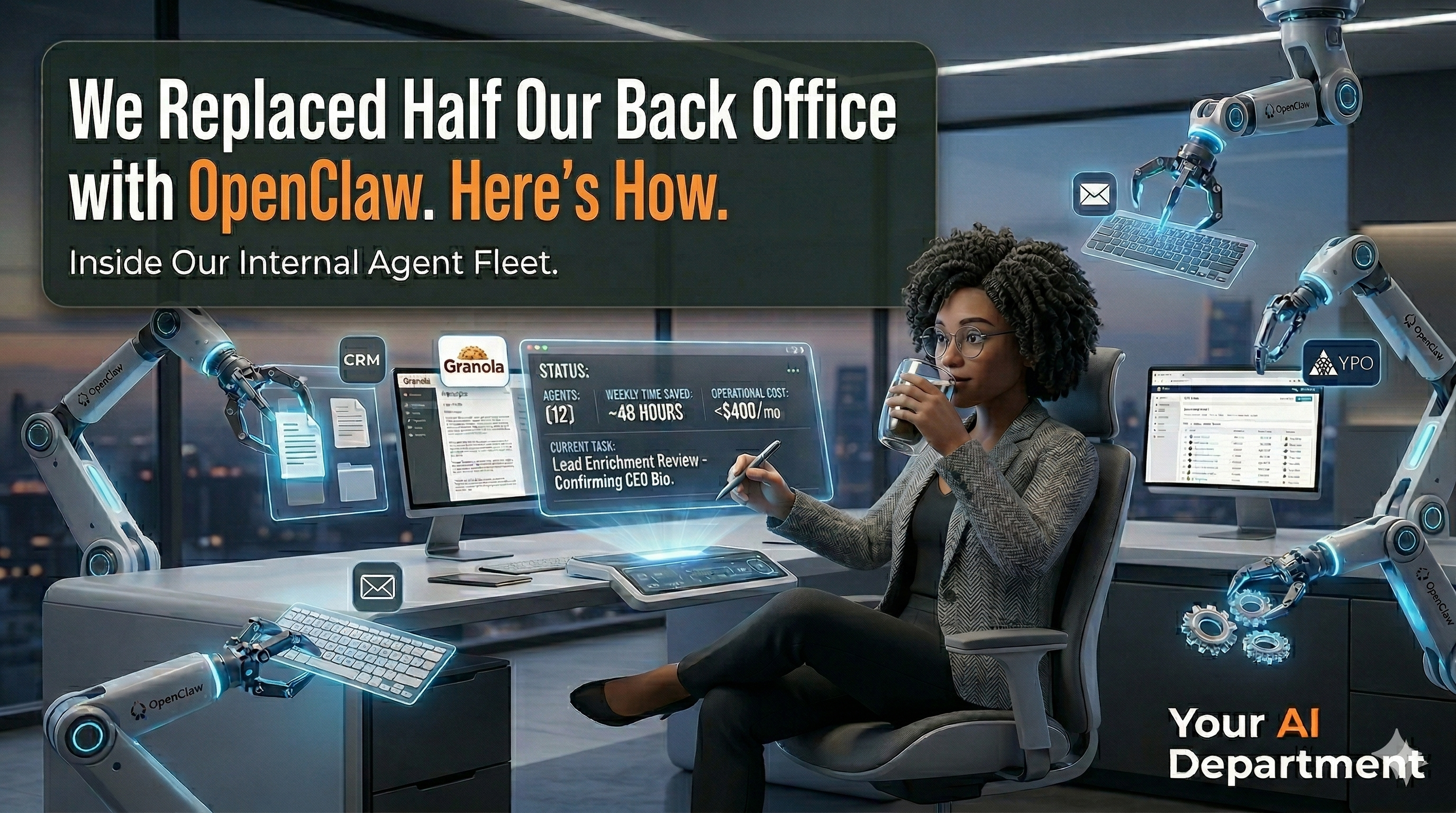
Automations vs Agents (And Why It Matters)
Automations follow fixed paths and boost productivity by 15%, but don't change your headcount math• AI agents make judgment calls in complex scenar...
Nvidia Just Told Every CEO to Get an OpenClaw Strategy
OpenClaw is the first real "Cog" most companies will encounter - it doesn't make employees faster, it replaces workflows entirely• Nvidia launched ...

Why Your Best Employees Will Quietly Kill Your AI Project
Employee fear, not technical failure, is the leading cause of AI project death—the org chart kills projects, not the technology