
The Bottom Line
AI failure is a context problem, not a tech problem. The models are capable. Your plumbing isn't.
Off-the-shelf AI tools are just more silos. The last 20% of accuracy costs your team more time than doing it manually.
Start where the pain already is, not where the demo looks coolest. Constrained teams adopt. Comfortable teams resist.
What We Learned From 190 CEOs
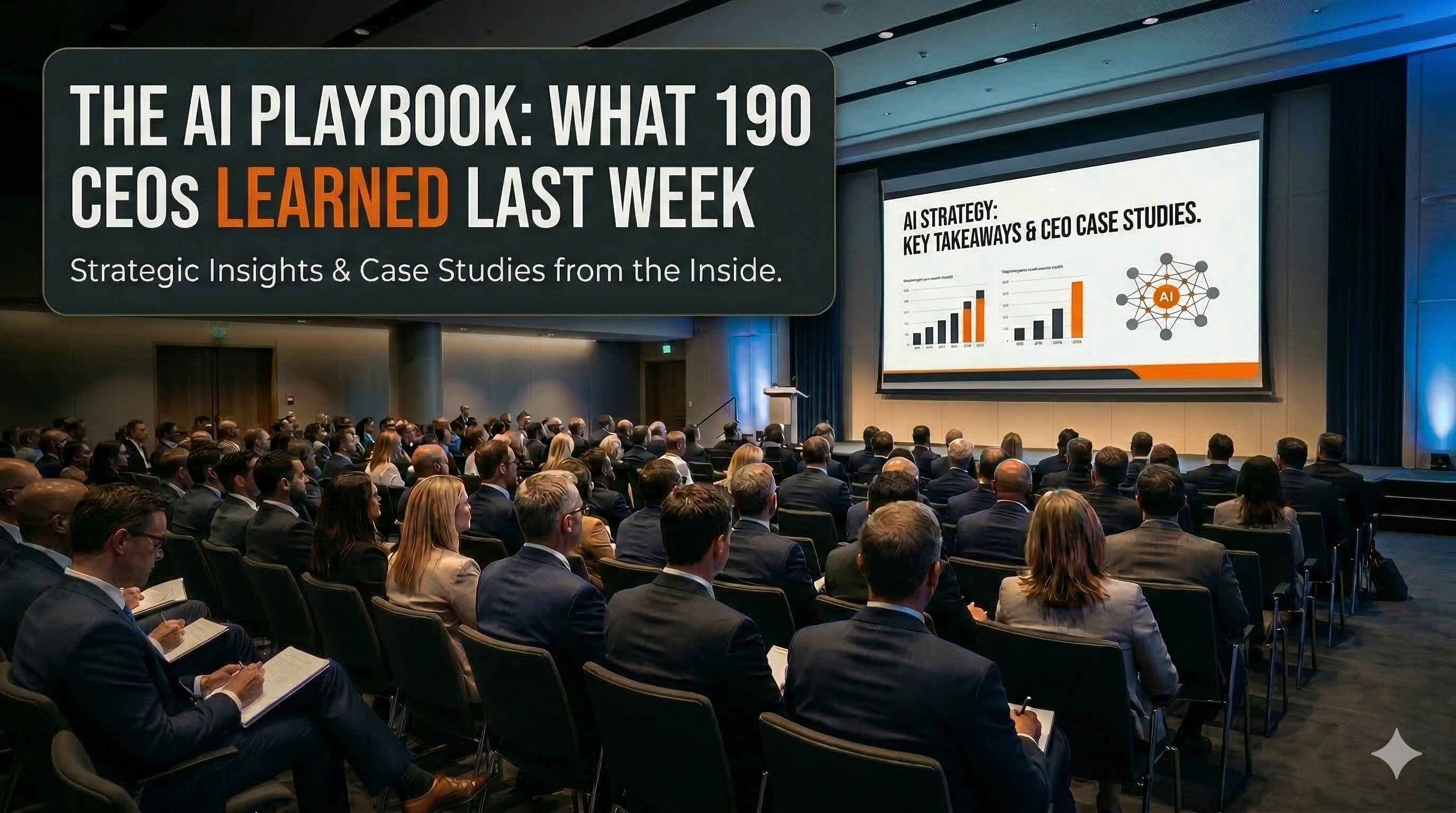
Last week, we ran a session with 190 CEOs across YPO on why AI investments aren't paying off and what to do about it. We live-built an AI agent during the call that qualified leads, enriched company data, and built a dashboard. It took about 15 minutes, and we were talking about something else the entire time.
Everyone was impressed how easily business value could be created.
Technology is not the bottleneck. What's broken is how companies are deploying it. Here are the six frameworks we walked through.
1. Cogs & Grease
You've probably bought ChatGPT licenses for your team. Your people are maybe 10% faster at writing emails and summarizing documents. That's Grease. It lubricates what's already there.
A Cog is different. A Cog replaces an entire workflow end to end. Not the person. The process. The 45 minutes your procurement lead spends every morning pulling data from three systems into a spreadsheet so she can find the problem? That's not a person problem. That's a process problem.
Most companies are stuck at Grease and wondering why the ROI isn't showing up on their P&L.
2. The Linear Ceiling
If doubling your revenue this year means doubling your support team, your ops team, or your sales team, that's your Linear Ceiling. Revenue can't outpace headcount.
We asked every CEO in the room: where would you break first?
That answer is your AI roadmap. The function where growth is physically constrained by the number of people you can hire is where AI capital goes first, because that's where the highest return is, and that's where your team already feels the need for help.
3. Atomic Units
"Automate our sales process" is not a project. It's a wish.
AI can't take a job description and become an employee. What it can do is execute one discrete task with one trigger and one output. Email comes in from a prospect, CRM gets updated. That's one atomic unit. Purchase order gets submitted, line items get validated against vendor pricing. That's another.
Stack enough atomic units together and you've got an automated workflow. A Cog. Stack enough Cogs, and you'll have a department. That's how the 15-minute demo worked: we didn't tell the AI to "do sales." We told it to read inbound emails from the audience, enrich the sender's profile using their domain and signature, and display the result.
4. Data Eligibility & Legibility
Before you build anything, audit what your AI can actually reach.
Eligibility: can the AI access the system? Is there an API, a webhook, an MCP connection, or is the data stranded on an island?
Legibility: can the AI read what's in there? HubSpot, Zendesk, most Fortune 50 SaaS products get a green light on both. But your industry-specific tools, your legacy ERP, the critical spreadsheet that lives on someone's desktop? Probably not.
Map your stack. Score every system on both dimensions and start with workflows with all greens.
5. Right-Sized Intelligence
One of the less obvious reasons AI projects fail: companies use a sledgehammer for everything.
Different AI models have different context windows and different capabilities. If you point a million-token model at a task that needs 50,000 tokens, it fills the gap by doing things you didn't ask for. It gets creative in the wrong direction.
The fix is one agent per task. Narrow scope, narrow access, narrow context. Then an orchestration layer that routes work between them, the way a manager delegates to specialists, not one generalist who does everything. The other fallacy is expecting AI to one-shot solve everything. It won't, and neither would an employee.
6. Change Management Is the Actual Bottleneck
CEO gets excited, commits a budget, announces the initiative, and then it dies at the director level.
It makes sense. The VP of Ops who's been running their function for eight years doesn't see a new tool. They see a disruption to a system that works and potential replacement of their role, introduced by someone who won't be the one debugging it at 2am.
Top-down mandates create compliance. They don't create belief. What works is finding the two or three people in your company who are already experimenting with Claude Code or ChatGPT on their own, your Shadow Users, and letting adoption spread from the middle. When your skeptical warehouse manager hears from his peer, not from the CEO, that "this saved me three hours last week," that's when the resistance breaks.
What To Do This Week
We built a working agent in 15 minutes during a live call. Imagine what a focused team builds in a quarter. Pick one function in your business that would break first if a big quarter hit. Ask that team lead to walk you through the first two hours of their day, step by step. Write it down and start hacking in Claude Code a proof-of-concept solution.
Book Your Free ConsultationShare this analysis
Related Insights

Why 61% of CEOs Are Burning Cash on "Weak AI"
AI is labor, not software—invest in it like a VP of Sales, not procure it like a tool
Automations vs Agents (And Why It Matters)
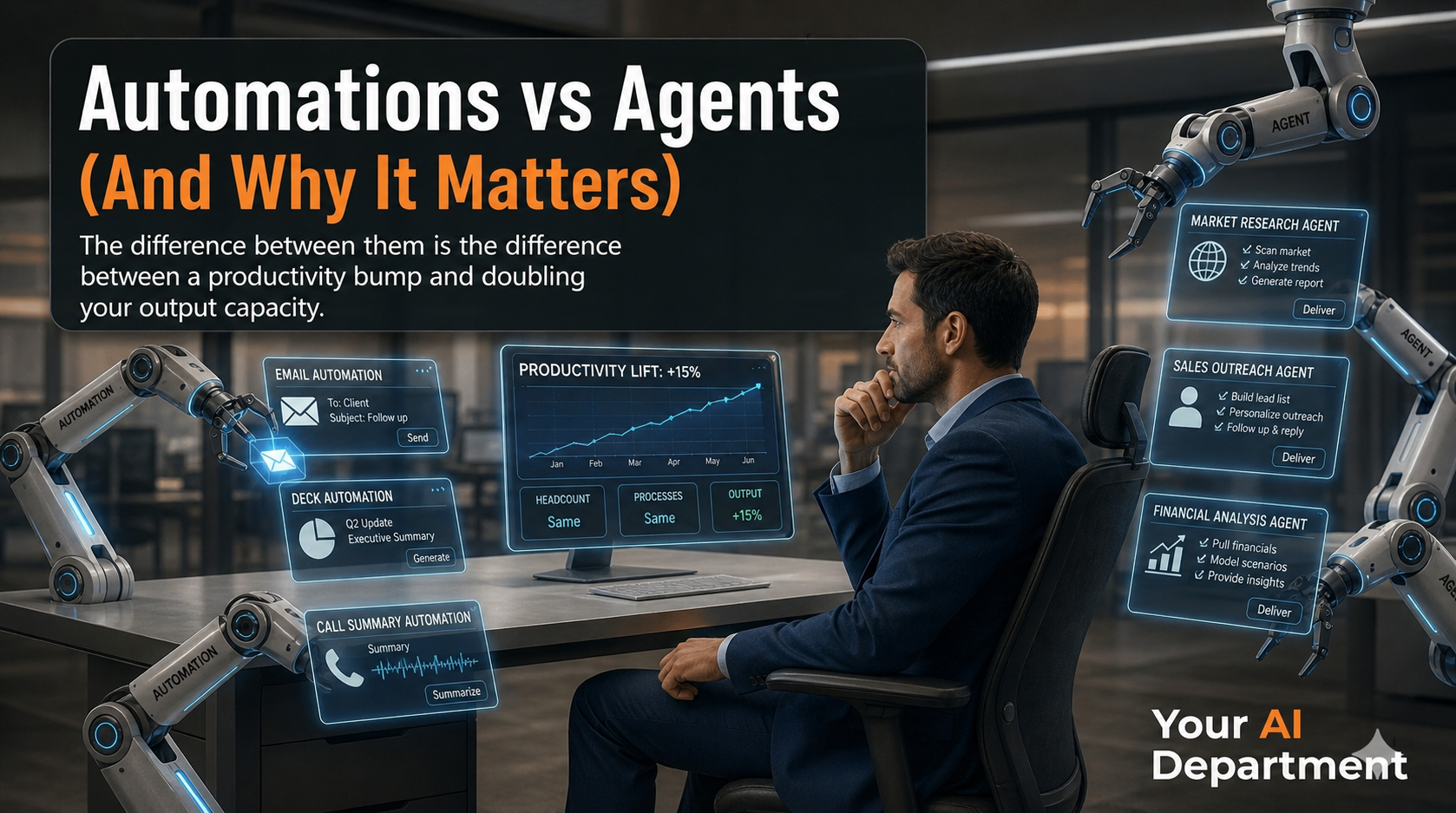
Automations follow fixed paths and boost productivity by 15%, but don't change your headcount math• AI agents make judgment calls in complex scenar...
10 AI Automations Your Competitors Deployed Last Quarter
"Grease" makes your team 10% faster. "Cogs" replace workflows entirely—running 24/7 without human prompting. • Below: 10 autonomous AI automations ...